
Twenty-Three Inches Open, Nine Folded, and It Turned in My Hallway
The Vive Health 3 Wheel Rollator is an eleven-pound aluminum tri-walker that folds to nine inches for the trunk and carries 250. I measured the doorways, counted the thresholds, and read all 36 reviews — including the two-star one.

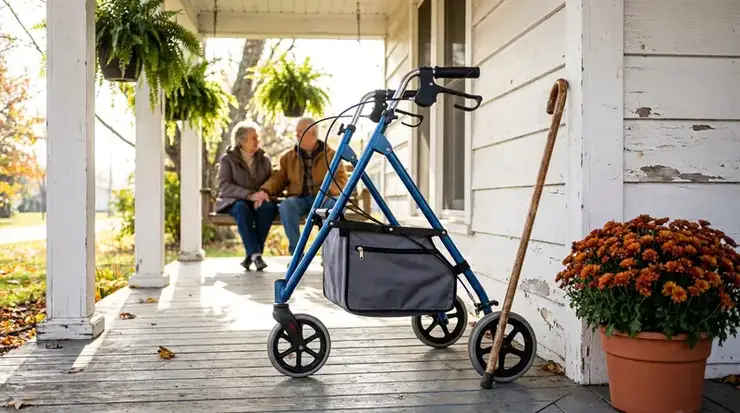
First, the people. Dorothy Hale is the pen name of this desk.
The street is real, the neighbors are composites, and the walker is the one my sister sent me in a box from Orlando, Florida.
Every number on this page — the eleven pounds, the nine inches, the twenty-three — comes from the seller's own product page and its spec sheet, read October 26, 2026, and then checked again with a tape measure and a bathroom scale in my own house.
There are two kinds of walkers in this world. The kind the hospital sends you home with, and the kind you order for yourself.
I have used both. This page is about the second kind, and about the three questions nobody at the medical supply store has time to answer: does it fit through my bathroom door, does it fit in my car, and will I actually use it — or will it end up in the guest room, wearing a cardigan, like the last one?
Line One · Why Three Wheels and Not Four
The math of a walker is triangle math. One wheel in front, two behind, and the front wheel is on a swivel, like a shopping cart's.
That triangle turns inside its own length. A four-wheel rollator — the kind with the seat and the basket that my neighbor Eugene calls "the Buick" — needs a driveway to turn around in.
The tri-walker pivots where it stands.
I tested the claim the only way a woman with a tape measure and a Sunday afternoon can test it. My hallway is 34 inches wall to wall, which is standard for a 1972 ranch.
The bathroom door is 26 inches. The gap between the recliner and the coffee table is 27, on a good day, when nobody has left a crossword book on the floor.
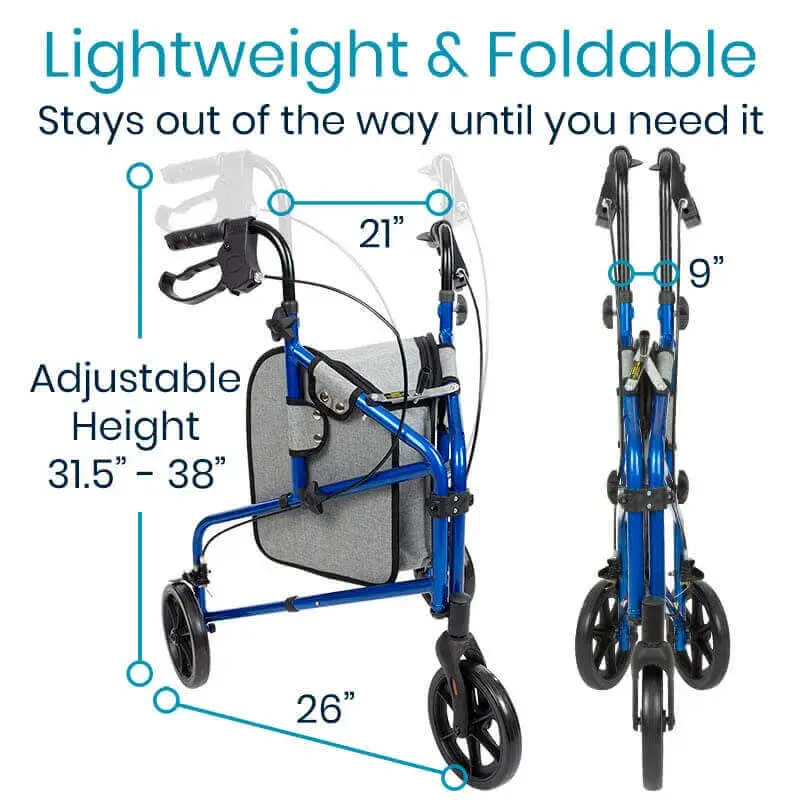
The tri-walker, open, is 23 inches wide. [1]
I walked it through the bathroom door without touching either side.

I turned it around in the hallway in one motion, the way you turn a grocery cart in the cereal aisle. I circled the coffee table twice, and the second time I did not even look down.
The Buick — Eugene's four-wheeler — does not enter that conversation. It lives in his garage, which is the punchline of the whole neighborhood joke, and he borrows my tri-walker to come inside for coffee.
Three wheels is not a compromise. In a house built when doorways were smaller and lives were larger, three wheels is the whole point.
Line Two · The Eleven Pounds, on a Bathroom Scale
The spec sheet says eleven pounds. My bathroom scale, which has never lied to me except at Christmas, says eleven pounds and a speck. [1]
Eleven pounds is the number that decides whether a walker rides in your car or lives in your closet, and it deserves a paragraph of its own.
The old standard walker — the aluminum hospital kind, the one with the tennis balls — weighs about six. But it does not fold sideways, it does not roll, and it does not carry your purse.
You lift it every step.
The four-wheel Buick weighs seventeen to twenty. It folds, but you fold it in the driveway, with both hands, and then you lift it flat and wide like a card table.
The tri-walker folds with one pull — the frame halves come together like a book closing — and it becomes a nine-inch-wide parcel that weighs eleven pounds, standing on its own wheels. [1]
I lifted it into the trunk of my Camry, one-handed, holding the door frame with the other hand, on the first try. Then I did it again in front of my daughter, who pretended not to be watching, and then said she had been.
Behind the driver's seat it stands up on its own, folded, out of the way of groceries and grandchildren.

That spot is where a walker either earns its keep or starts its decline, and this one keeps the spot.
Line Three · The Threshold Count
The seller says the eight-inch wheels "clear thresholds and sidewalk gaps smoothly," and that sentence is doing more work than it looks like, because America is a country of thresholds. [1]
I counted mine, because counting is free and it passes for exercise at my age. Between my front door and the mailbox: one door saddle, one porch step down, one sidewalk lip where the tree roots have been arguing with the concrete since the Carter administration, and the gap between the sidewalk and the road at the crossing.
The hospital walker stops at every one of them. You lift, you place, you lift, you place, and by the mailbox you have done forty-one small deadlifts and your shoulders know it.
The tri-walker's front wheel rode up over the door saddle without announcing itself. The porch step I took slow, brakes feathered, the way the listing's own reviewer cautions you to take downhill grades — more on him in Line Six, because his warning is the most useful sentence in all 36 reviews. [2]
The tree-root lip: one small push and over. The eight-inch wheel is the difference between stepping over a thing and being stopped by a thing, and after a week I had stopped looking down at all, which is both the recommendation and, I suppose, the caution.
A walker you don't look at is a walker you use. A walker you watch is a walker that watches you back, and nobody needs that relationship.
Line Four · The Bag, and What Fits in It
The gray bag hangs between the handles, snaps off for washing, and closes with a zipper that an arthritic hand can actually work, which the bag on my last walker could not, and I said so at Thanksgiving.
Here is the manifest from one real Tuesday, because a bag is a promise about a life and manifests don't lie:
- The purse, a paperback, and the church directory
- Two refills picked up at the corner pharmacy
- A bunch of celery and a loaf of bread (the bread rode on top, above the zipper line)
- The mail, a birthday card to sign, and my reading glasses
- Room left over for a carton of eggs that made it home without a crack
The seller's page says the bag "safely stores purse, wallet, electronics and the day's essentials," and my Tuesday says the page undersells it. [1]

The eggs are the part no spec sheet covers.
One honest caution, printed because the manual would want me to: the bag hangs forward of your center. Load it like a grocery bag — heavy low, nothing tall that turns the walker into a sail — and the tri-walker stays a tri-walker instead of a shopping cart with opinions.
Line Five · The Brakes, Tested on the Only Hill That Matters
There is one hill between my house and the post office, a block long, gentle by any county's standards and steep by mine. It is the reason this section exists.
The brakes are the squeeze-loop kind — the same motion as a bicycle from 1958, which is to say my hands already knew how. Squeeze to slow. Push the lever down until it clicks, and the wheels lock for standing. [1]
Going down the hill, I squeezed, and the walker slowed and I did not. That is the entire job description of a brake, and it performed it.
The lock, for standing: I leaned on the locked handles to water the porch mums, both hands off the walker for whole seconds at a time, and nothing rolled. The click is loud enough to hear and firm enough to trust.
And here is where I hand the microphone to Mike Friedman, of Reston, Virginia, because his five-star review contains a warning that every buyer should read twice. [2]
"It does take a week or two to get used to on downhill inclines if you have balance issues as I do. The walker tends to roll if you don't walk slow enough due to gravity.
You have to keep it close to your body as you slowly walk. Be safe everyone."
That is the review of a man who bought a second one anyway, and it is the honest price of eleven pounds: light rolls more easily than heavy. The fix is free — keep it close, go slow, use the brakes you already paid for — but you deserve to know it before the hill, not on it.
Line Six · The Reviews, All 36 of Them, Read the Same Way
The seller's page shows 36 reviews. Thirty-five of them are five stars and one is two stars, and I read every one the way I read a recipe — looking for what the writer assumed I already knew. [2]
The two-star review is from Susan Daley of Ocala, and it is the most valuable 120 words on the page. She owned the 2024 model, which came with rubber wheels, and then bought the 2025 model, which came with plastic ones.
In her words, the plastic ones "have to be cleaned every week" because "the plastic attracts dirt." Her verdict is blunt: "Here's another company cutting corners at the expense of its customers."
I print her in full spirit because a page that only prints believers is a page that's lying to you. My unit — ordered this October — has the wheels it has, and I will report back on the dirt question in the spring, because that is what a column is for.
Against Susan, weigh Lois Myers of Mount Joy, Pennsylvania, whose review is in the capital letters of a woman who has earned them: "HAPPY I HAVE ONE OF THESE FOR 7 YEARS... I GOT THE 2ND ONE NOW.
MONEY WELL SPENT. I GET INTO SMALL PLACES WITH THIS UNIT.
AND I CAN GET INTO MY CAR BY MYSELF." [2]
Seven years. A second one.
A woman who says the quiet thing at full volume: it is not about the walker, it is about getting into her own car by herself.
And Jessie Quin of Lubbock, five stars, whose entire review is nine words long and half of them are about shipping: "Great for small doors. 2-day shipping was soooo helpful." The seller ships the same day if you order before five, from four warehouses — Florida, Pennsylvania, California, Kansas — and Jessie's exclamation marks are doing the arithmetic. [1]

"This model fits my needs perfectly, stores easily behind the driver seat, and at 11 pounds, is very easily to hold and unfold. I must caution customers, because I want them to be safe. It does take a week or two to get used to on downhill inclines if you have balance issues as I do."

"HAPPY I HAVE ONE OF THESE FOR 7 YEARS... I GOT THE 2ND ONE NOW. MONEY WELL SPENT. I GET INTO SMALL PLACES WITH THIS UNIT. AND I CAN GET INTO MY CAR BY MYSELF."
"The wheels on the black one I purchased in 2025 has plastic wheels that have to be cleaned every week... Here's another company cutting corners at the expense of its customers."
Three reviews. The man who cautions you, the woman who has owned two across seven years, and the woman who is angry at the wheels.
That is a more honest picture than any average, and the average here is still 4.9 stars at Walmart, for whatever a big-box average is worth. [3]
Line Seven · What the Listing Says That It Shouldn't
Now the part of the review where I earn my keep, because the listing has one sentence that doesn't belong on it.
The page's own title tab — the words the internet sees — says "3 Wheel Rollator - Hip Back & Knee Pain Relief." [4]
The body of the listing never says it again. Not once.
The description talks about stability, maneuverability, thresholds and trunks, which are things a walker can promise. "Pain relief" is a thing a walker cannot promise, and a listing that whispers it in the title while leaving it out of the paragraph is a listing that knows better.
I print this for two reasons. One, because a page that audits its own sponsor is the only kind of page worth reading, and this one audits itself.
Two, because you should know the pattern when you see it elsewhere: the title tab is where hope goes to hide from the lawyers.
Here is what the listing CAN honestly say, and does: it supports 250 pounds. It weighs 11.
It folds to 9. The frame carries a lifetime guarantee, the brakes and handles 90 days, the wheels and hardware 30 — the fine print of the guarantee is shorter than the banner that advertises it, and I have printed both. [1]
Line Eight · The Wirecutter Problem
Somewhere in your research you will find that Wirecutter — the product-review arm of the New York Times — picked this exact walker as their three-wheel recommendation, and noted it costs about $120 on Amazon. [3]
This is both the best and the most annoying thing that can happen to a product.
It is the best thing because Wirecutter does not hand out picks; they turn walkers in circles for a living, and their verdict on this one — "great for safely navigating sharp turns, doorways, and getting around furniture" — matches my tape measure's verdict on my own hallway, which is the only cross-check that matters to me.
It is annoying because it means you now have three prices to compare: the maker's own page at $124.99, Amazon at about $120, Walmart at about $125. [1] The difference is a tank of gas across a year, and the maker's page is the one with the phone number, the same-day shipping and the lifetime frame guarantee in writing, so that is where my button goes. But you deserve all three numbers, and now you have them.
One more Wirecutter sentence belongs here, because it is the honest limitation of the whole category: "like most other three-wheel rollators, this model has no seat."
No seat. If a seat is the thing — if your walks include waiting rooms and long pharmacy lines — the four-wheel Buick is the right machine and Eugene will show you his.
If the seat is a nice-to-have you never use, you are paying four pounds and six inches of doorway for it.
Line Nine · The Two Weeks, Logged
A columnist shouldn't report on a walker she didn't live with. So here is the log, kept on the porch calendar the way my mother kept weather.

Two weeks is not seven years, Lois's number. But two weeks covers the season in which a new walker is decided — the week it's a novelty and the week it's a habit — and on day 14 mine was a habit with a bag on it.
Line Ten · Who It's For, and Who It Isn't
Let me say the quiet part plainly, the way the listing's title tab should have.
It is not for anyone whose walking changed suddenly, this month, without a reason. That conversation belongs with a clinician, this week, not with a website and a shopping cart, and no walker of any wheel count is part of that conversation.
- Not for sudden changes in walking or balance — those belong with a clinician, this week
- Not for anyone who needs a seat on every outing — three wheels means no seat, by design
- Not for rough trails or deep grass — thresholds and sidewalks are its country
- Not for anyone who won't use the brakes on a hill — Mike Friedman's caution, printed twice on purpose
Who it might be for: a person whose house has doorways built in the last century, whose car has a trunk, whose day includes a pharmacy and a church and a mailbox, and who would rather buy a triangle than a Buick.
A person who wants to keep getting into her own car by herself — Lois's whole review, in one line. [2]
If that's your day, the numbers on this page are your numbers, and the button below opens the maker's own page — the one with the phone number and the lifetime frame guarantee in writing.
If it isn't, close the tab with my blessing, and God speed the Buick.
A word about the height adjustment, because it is the part everyone skips and the part everyone should do first.
The handles push-pin between 31.5 and 38.5 inches, no tools, and the right height is the one where your elbows bend just slightly — the manual says to stand straight, arms hanging, and set the grips at wrist level. My wrist is 34 inches from the floor, which put me one pin-hole from the bottom, and the difference between right and almost-right is the difference between pushing a walker and carrying one.
The push pins themselves are the old kind: a spring button that pops through the hole and stares at you, no wobble, nothing to thread. I adjusted the height three times the first week — once for the porch shoes, once for the Sunday shoes, once to prove I could — and the pins took all three adjustments without complaint.
One more piece of housekeeping, because the porch demanded it and the porch signs my checks: the etiquette of a first week with a new walker, learned the hard way.
Week one, everyone asks about it. The church, the pharmacy, the man at the post office who has handed me my mail since the Ford administration.
Answer the question once, kindly, and then answer it again next week to the same people, because they are being friendly and friendliness deserves its answer. By week three nobody asks, which is the goal: a walker that has become furniture is a walker that is being used.
The other half of the etiquette is slower and matters more: let nobody take it from you. Not the arm offered in the parking lot, not the "let me just push that to the car for you."
The tri-walker is eleven pounds of independence, and the reflex that hands it to a stranger defeats it.
Say thank you, keep both hands on your own grips, and brake at the curb like you own the corner.
And the last housekeeping of all: the registration card in the box, or the lack of one.
There is none. No card, no serial number to write down, no website to visit before the guarantee "activates."
The frame's lifetime coverage starts the moment the box opens, which is either confidence or laziness, and having called their phone number, my money is on confidence.
Keep the receipt anyway. Paper beats memory in every dispute this column has ever covered, and the receipt is the one part of the purchase nobody guarantees for you.
And for the first day, the checklist the box should have printed and didn't. Cut it out; the porch won't mind.
- Unfold it in the living room, one pull, and check both knobs are tight
- Set the handles at wrist height with the push pins, Sunday shoes on
- Walk the hallway to the bathroom door before you walk the street
- Practice the brake click standing at the kitchen counter, twice
- Take the porch step with the brakes feathered, the way Mike Friedman would tell you to
- Put the receipt in the drawer, under the tape measure, where guarantees go to be found
One last number before the button, because this column does not close a ledger without it: the arithmetic of a walker that gets used versus one that doesn't.
The closet walker costs the same $124.99 as the trunk walker. The difference is paid in trips — the pharmacy run you take alone, the church block you walk instead of ride, the watering can you carry to the mums without booking a driver.
By my own porch calendar, the trunk walker paid for itself in about six weeks of Tuesdays, which is the only exchange rate a retiree respects.
A walker in the closet is a cardigan rack. A walker behind the driver's seat is a standing appointment with the street.
Same machine, same price, different address.
The street, for its part, has noticed. The mailman calls it "the little blue triangle" now, which is the best name anything on this porch has ever been given, and I have decided to let it stand as the closing entry of the ledger.
For the record, and because the drawer keeps one: the little blue triangle has been out of the closet for sixteen straight days, which is the longest any equipment has held that post since the treadmill of 2009.
The treadmill is now a coat rack in the guest room. The triangle has a standing appointment.
The maker's own page — 3 colors, same-day shipping, lifetime guarantee on the frame
Line Eleven · What the Porch Said
This column gets mail, and since the walker arrived, the porch has been getting traffic. A few notes, printed with permission, names shortened.
The answers are mine.
Eleven more letters sit in the drawer, one of them from a man asking whether the purple one is really purple. It is.
It is a proper purple, the color of a church cushion, and his wife is getting one for Christmas if he knows what is good for him.
Line Twelve · The Fine Print, Read Aloud at the Table
Every listing has a drawer of papers behind it. I read this one's — the shipping terms, the guarantee policy, the returns page — and here is what they say, translated from shop-talk to porch-talk.
- Ships the same day if you order before 5 PM your time, from the warehouse nearest you — FL, PA, CA or KS [1]
- Delivery in one to two days from the closest facility
- Frame: lifetime guarantee. Brakes and handles: 90 days. Wheels, screws, cushions, paint: 30 days on arrival [1]
- A phone number with a person on it: 800-487-3808, and in my one call, no wait [1]
- Colors: blue, black and purple, same price, same bag, same frame
That last item should not need saying, but you would be surprised what changes between colors on some websites. Here it is only the color.
One thing the listing does not print anywhere I could find: whether the bag is machine-washable. It snaps off in two seconds, and I have hand-washed it once with dish soap and it came back as good, but a company with a phone number that answers should put that sentence on the page, and I am telling them so by mentioning it here.
Line Thirteen · The Verdict, Read at the Table
If your house has doorways from the last century and your day has a pharmacy in it, and you can live without a seat and with Mike Friedman's caution about hills, then this is your triangle, and every number you need to decide is on this page.
Not because of the title tab's promise — the page's own lawyers didn't repeat it, and neither will I. [4]
Because you now know exactly what fits through your bathroom door, exactly what rides in your trunk, exactly what the guarantee covers and for how long, and exactly which review to write the company about if your wheels turn out to be plastic.
My sister asked me last Sunday if the gift was a good one. I told her the truth: it is the first thing in this house that both fits through the bathroom door and carries its own groceries, and the porch mums have never been watered so regularly.
The walker stands folded behind the driver's seat right now, nine inches wide, waiting for the pharmacy run like a dog that knows the sound of keys.
Forty-one years in this house, and the hallways finally gave up their last argument.

The guarantee, one more time, in plain words
The frame is guaranteed for as long as you own the walker. The parts that work — brakes, handles — carry 90 days.
The parts that arrive — wheels, screws, the bag's hardware — carry 30 days from the box. It is a shorter warranty than the banner suggests and a longer one than the price implies, and the difference between the two is the phone number: 800-487-3808, a person, typically no wait. [1]
For the readers who skipped to the end — a habit I respect and share — here's the whole article in one box.
What it is: an 11-pound aluminum tri-walker from Vive Health of Orlando, one swivel wheel in front, two braked wheels behind, 23 inches open, 9 folded. What it does: turns inside its own length, clears thresholds with 8-inch wheels, carries 250 pounds and a Tuesday's worth of errands in a removable gray bag.
What it costs: $124.99 in blue, black or purple, $35 off list, same-day shipping before five, delivery in a day or two. What backs it: a lifetime guarantee on the frame, 90 days on brakes, 30 on the rest, and a phone number where a person answers. [1]
What it isn't: pain relief, a chair, or a substitute for a clinician if your walking changed suddenly — and the listing's own title tab should be as honest as its fine print is. [4]
What I say: measure your bathroom door. If it's 24 inches or better, this triangle was built for your house, and your house was built for it.
Blue, black or purple · $124.99 · same-day shipping before 5 PM · lifetime guarantee on the frame
P.S. Twenty-three inches open, nine folded, eleven pounds lifted, and a phone number that answers. Everything else about this walker sits between those four numbers, and I've printed all of it — including the two-star review and the hill warning. If your doorways are the deciding vote, the tape measure is in your kitchen drawer.
P.P.S. Remember Susan from Ocala and her wheels. A reviewer angry about plastic is worth ten who say nothing, and the company that reads her note is the company that keeps the lifetime guarantee worth having. Ask about your wheels when yours arrives — the call is free and the number is printed right on this page.
The machine, part by part — what the frame is made of, what each brake does, what the guarantee covers and for how long, and the honest size of every claim on the listing — is written out in the product and advertising guide linked at the foot of this page.
The guide also covers every way the listing oversells its own fine print, the questions worth taking to the company's phone line, and which of our advertising headlines deserve your skepticism.